For decades, industrial agriculture has been sold as a triumph of efficiency. Bigger yields. Cheaper food. Predictable supply chains. And for a while, it delivered exactly that. But beneath the surface—literally—the long-term environmental costs have been stacking up. Soil is thinning, water is carrying more chemicals than ever, and ecosystems downstream are paying the bill.
This isn’t a sudden collapse story. It’s a slow erosion, measured in lost nutrients, polluted aquifers, and rivers that no longer behave like rivers should. The impacts are cumulative, and they’re becoming impossible to ignore.
How Industrial Agriculture Changed the Land
Industrial agriculture is built on scale and specialization. Monoculture planting, heavy mechanization, synthetic fertilizers, and chemical pest control became the norm after World War II. The goal was straightforward: maximize output per acre.
That model reshaped soil from a living ecosystem into a production medium. Instead of diverse microbial communities cycling nutrients naturally, soils were pushed to respond to external inputs—nitrogen, phosphorus, potassium—applied on a schedule.
According to the Food and Agriculture Organization, more than 30% of the world’s soils are now moderately to highly degraded, largely due to intensive farming practices, a trend documented at https://www.fao.org.
Soil Health: The Invisible Casualty

Healthy soil isn’t just dirt. It’s a complex mix of minerals, organic matter, fungi, bacteria, insects, air, and water. Industrial farming disrupts that balance in several ways.
Repeated tilling breaks down soil structure, making it more vulnerable to erosion. Monocultures reduce biodiversity below ground, weakening natural pest resistance. Synthetic fertilizers feed crops directly but bypass soil biology, reducing organic matter over time.
The result is soil that holds less water, resists roots, and needs increasing chemical inputs to stay productive.
Erosion and Nutrient Loss

The U.S. Department of Agriculture estimates that U.S. croplands lose billions of tons of topsoil annually due to erosion, data summarized in conservation reports at https://www.usda.gov. Topsoil forms slowly—often taking hundreds of years to replace what’s lost in a single storm.
As soil thins, nutrients wash away into waterways instead of nourishing crops. Farmers compensate with more fertilizer, locking the system into a feedback loop that accelerates degradation.
Chemical Inputs and Long-Term Soil Toxicity
Herbicides, pesticides, and fungicides play a central role in industrial agriculture. While many are regulated and tested for short-term safety, long-term environmental accumulation tells a different story.
Some chemicals persist in soils for years, altering microbial communities and reducing beneficial organisms like earthworms and nitrogen-fixing bacteria. Studies cited by the U.S. Environmental Protection Agency show that repeated chemical exposure can reduce soil biological activity, even when crop yields remain stable in the short term. EPA soil and pesticide assessments are available at https://www.epa.gov.
Over time, soils become chemically dependent but biologically depleted—productive on paper, fragile in reality.
Water Quality: Pollution That Travels Far
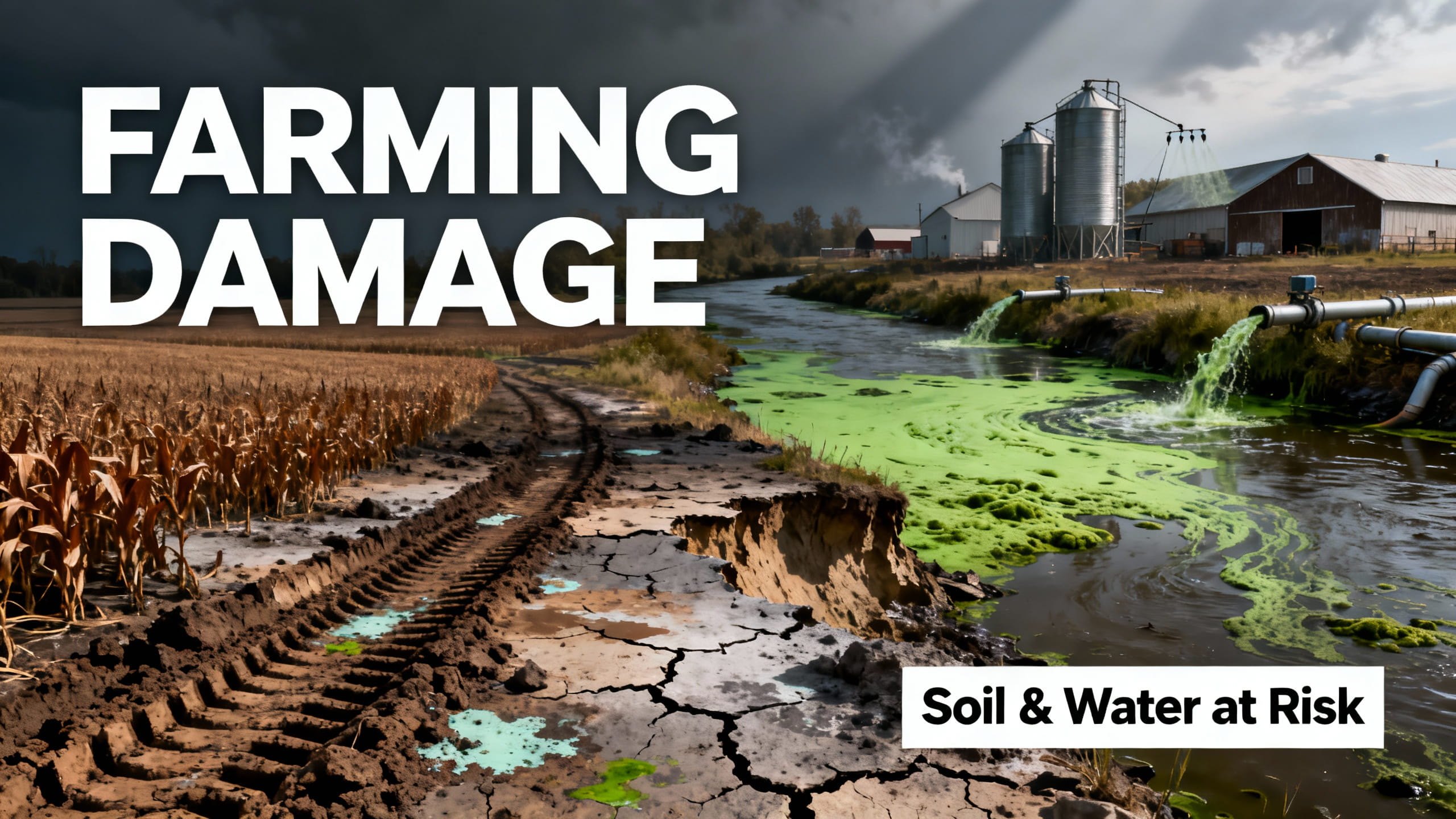
What happens on farms rarely stays on farms. Rainfall and irrigation move excess fertilizers, manure, and chemicals into streams, rivers, lakes, and aquifers.
Nitrogen and phosphorus runoff is the most visible problem. These nutrients fuel algal blooms that consume oxygen as they decay, creating “dead zones” where fish and invertebrates cannot survive.
The Gulf of Mexico dead zone, one of the largest in the world, is directly linked to agricultural runoff from the Mississippi River Basin. The National Oceanic and Atmospheric Administration tracks this annually at https://www.noaa.gov.
Groundwater Contamination
Surface water isn’t the only concern. Nitrates from fertilizers seep into groundwater, contaminating drinking supplies—especially in rural areas dependent on private wells.
The U.S. Geological Survey has documented widespread nitrate contamination in agricultural regions, with some aquifers exceeding safe drinking limits, findings published at https://www.usgs.gov.
Unlike surface water pollution, groundwater contamination is incredibly difficult to reverse. Once an aquifer is polluted, cleanup can take decades, if it’s possible at all.
| Impact Area | Primary Cause | Long-Term Effect |
|---|---|---|
| Soil fertility | Intensive tillage | Reduced yields over time |
| Water quality | Nutrient runoff | Algal blooms, dead zones |
| Groundwater | Nitrate leaching | Unsafe drinking water |
| Ecosystems | Chemical exposure | Biodiversity loss |
Livestock Operations and Manure Overload
Industrial animal agriculture compounds the problem. Concentrated Animal Feeding Operations (CAFOs) produce massive volumes of manure, often exceeding what nearby land can safely absorb.
When manure lagoons leak or overflow—especially during floods—pathogens and nutrients enter waterways. The EPA has linked CAFO runoff to bacterial contamination and fish kills, detailed in livestock regulation summaries at https://www.epa.gov.
Even when applied as fertilizer, excessive manure can overload soils with phosphorus, increasing runoff risks for years afterward.
Climate Change Makes the Damage Stick
Climate change amplifies every weakness in industrial agriculture’s environmental footprint.
Heavier rainfall events increase erosion and runoff. Longer droughts reduce soil organic matter and microbial resilience. Warmer temperatures accelerate chemical reactions and nutrient cycling, making pollution events more intense.
The Intergovernmental Panel on Climate Change notes that degraded soils are less capable of storing carbon and water, worsening both climate impacts and agricultural vulnerability. These conclusions are outlined in IPCC land-use assessments at https://www.ipcc.ch.
In other words, soil and water degradation isn’t just an environmental issue—it’s a climate risk multiplier.
Can the Damage Be Reversed?
Not fully. But it can be slowed, and in some cases, partially repaired.
Practices Showing Promise
- Cover cropping to protect soil and add organic matter
- Reduced or no-till farming to preserve structure
- Precision fertilizer application to limit runoff
- Buffer strips and wetlands to filter pollutants
The Natural Resources Conservation Service promotes many of these practices through voluntary programs, with technical guidance available at https://www.nrcs.usda.gov.
However, adoption remains uneven. Industrial systems are optimized for short-term output, not long-term resilience. Changing that equation often requires policy incentives, market pressure, and consumer awareness working together.
Fact Check: Is Industrial Agriculture the Main Driver of Soil and Water Degradation?
Yes, according to multiple independent assessments. While not the only factor, industrial-scale farming is consistently identified by the FAO, EPA, and IPCC as a leading contributor to soil degradation, nutrient pollution, and freshwater contamination worldwide. These conclusions are based on decades of peer-reviewed research and government monitoring data.
Where This Leaves the Food System
Industrial agriculture has fed billions, but it has also borrowed heavily from the future. Soil loss and water pollution don’t announce themselves with sudden collapse; they show up as declining resilience, rising costs, and ecosystems that no longer bounce back.
The long-term environmental impact is not hypothetical. It’s measurable, mapped, and increasingly visible in the rivers, wells, and fields that sustain food production. The question now isn’t whether the system has environmental costs—it’s how long those costs can be absorbed before productivity itself begins to fail.
FAQs
How does industrial agriculture degrade soil over time?
Through intensive tillage, monocropping, and chemical inputs that reduce organic matter and microbial diversity.
Why is fertilizer runoff such a major problem?
Excess nutrients wash into waterways, causing algal blooms, oxygen depletion, and drinking water contamination.
Can polluted groundwater be cleaned up?
In most cases, cleanup is extremely slow and expensive, making prevention far more effective.
Are organic or regenerative practices better for soil and water?
Studies generally show they improve soil structure and reduce runoff, though yields can vary by region.